Soft Skills on Your CV: How to Actually Make Them Count

Yes, put your soft skills on your CV, but not as a list of adjectives. "Rigorous, autonomous, good communicator" is what almost every candidate writes, so it tells the reader nothing. Soft skills can't be claimed, only evidenced: a short situation, what you did, and what changed. Here is how to make that switch.
Should you put soft skills on your CV?
Yes. Whoever reads your CV wants to know two things: can you do the work, and how will you do it. Your experience answers the first. Your soft skills answer the second, and they often decide between two similar profiles.
A list fails for two reasons:
- It can't be checked. Anyone can write "team player".
- It is the same as everyone else's. A reader skims past it the way you skim past terms and conditions.
The question isn't whether to mention your soft skills. It's how to make them believable.
How do you identify your own soft skills?
Most people can't name theirs, or they name the ones they think they should have. This short method works better than any list:
- Write down what people come to you for. Untangling a messy file before a client meeting, calming down a tense call, writing the email nobody else wants to write.
- Write down what you do without being asked. Sharing a clean summary after a confusing meeting, checking in on the new person, fixing the process that keeps breaking.
- Name the skill behind each habit. "People ask me to rewrite their client emails" points to written communication and tact. "I always end up organising the handover" points to structure and reliability.
Tip
Ask two former colleagues when they would call you, and when they wouldn't. The second half of the answer is as useful as the first.
If you need the vocabulary, our soft skills definition and list covers the main ones.
How do you prove a soft skill instead of claiming it?
Replace the adjective with a short situation: what was going on, what you did, what changed. One line is enough. It doesn't need to be heroic. It needs to be specific.
Four rewrites, from four different lines of work:
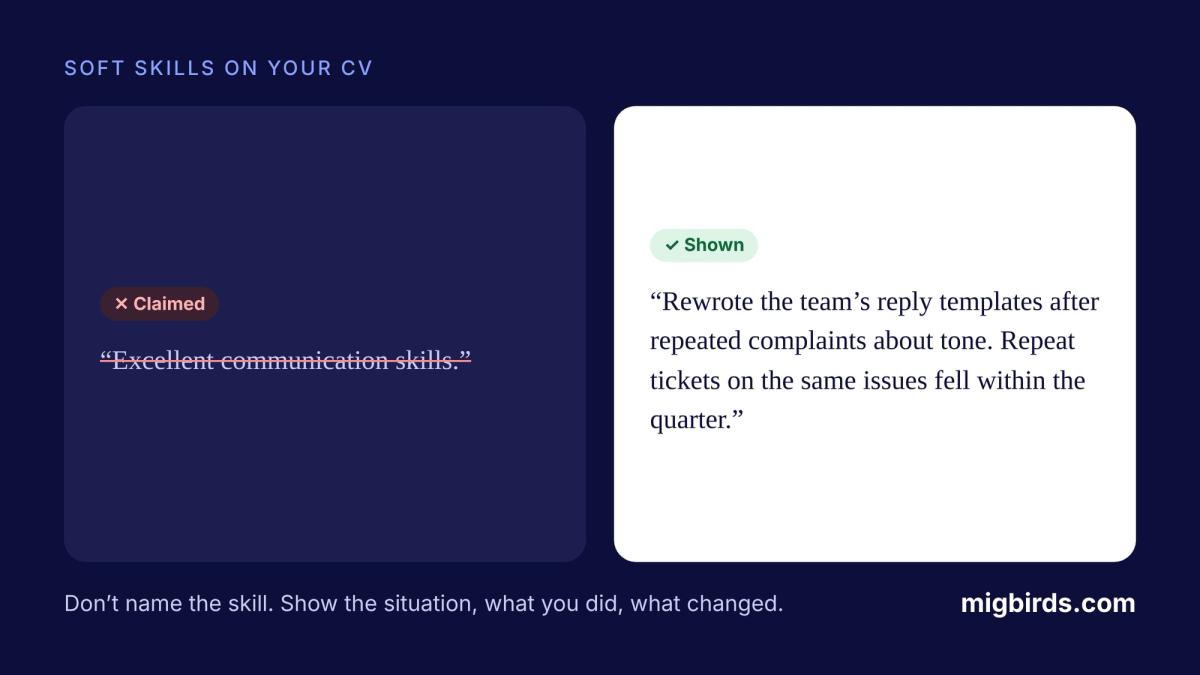
Communication, in customer support
- Before: "Excellent communication skills."
- After: "Rewrote the team's reply templates after repeated complaints about tone. Repeat tickets on the same issues fell within the quarter."
Autonomy, as a freelance developer
- Before: "Autonomous and proactive."
- After: "Took over a payment integration with no handover notes, rebuilt the missing specs with the client's finance team, and delivered before their year-end close."
Adaptability, in event management
- Before: "Adaptable, works well under pressure."
- After: "When the venue cancelled four days before a conference, found and set up a new site and rerouted every attendee without a single cancellation."
Team spirit, in industrial maintenance
- Before: "Team player."
- After: "Set up a fifteen-minute handover between night and day shifts, so recurring faults stopped being rediscovered every morning."
Look at what the "after" versions have in common: none of them names the soft skill. They don't need to. The reader infers it, and a trait the reader infers is far more convincing than one you announce.
Note
If you have a number, use it. If you don't, a precise situation does the job. Never invent one.
Where should soft skills go on a CV?
Inside your experience, not in a separate block at the bottom. The evidence lives in what you did, so that is where the skill belongs. A "soft skills" section at the end tends to turn back into a list of adjectives.
If you want a summary at the top, keep it to one sentence that names two traits and points to where they show up:
"Project lead who keeps cross-functional teams aligned when the brief keeps moving. See the ERP migration and the warehouse relaunch below."
Which soft skills should you highlight for each mission?
The ones the mission actually needs. A list is generic; a selection is a strategy.
Read the mission description for how the work is done, not only what it is:
- "Evolving priorities" calls for adaptability.
- "Several stakeholders, client-facing" calls for communication and diplomacy.
- "Small team, little supervision" calls for autonomy.
Then move your strongest evidence for those traits to the top of each experience. Same CV, different order.
For freelancers this matters even more. A client hires you for a defined mission and wants to know you will fit their way of working from day one. If you are choosing between missions right now, here is how to tell whether one fits the way you work.
Your soft skills are your strength, not something to apologise for. Make them as visible as any other result. And if you would like to see missions where they count, your Migbirds profile looks at your soft skills, working style and motivation to predict which missions fit how you work.
Frequently asked questions
- How many soft skills should you put on a CV?
- Three to five, each backed by something you actually did. A few well-evidenced traits beat a long list nobody believes.
- Should you have a dedicated soft skills section?
- Usually not. A separate section invites a list of adjectives. Put the evidence inside your experience, and use a one-line summary at the top if you want to name the traits.
- How do you talk about soft skills in an interview?
- The same way, out loud: the situation, what you did, what changed. Prepare one short story for each trait on your CV, because that is exactly what the interviewer will ask about.
- Do recruiters check soft skills?
- They try to, through interviews, reference calls and how you behave during the process itself. An evidenced CV gives them something concrete to ask about, which works in your favour.
- Which soft skills should go on a freelance CV?
- The ones that reassure a client you can deliver without much onboarding: autonomy, clear communication, reliability on deadlines and the ability to adapt to a team's way of working. Show each one through a past mission.
Robertino Calcaterra
Growth & Marketing at Migbirds