Setting Your Day Rate: What Your Price Tells Clients

Most freelancers set their day rate by looking at what others charge and shaving a little off. That treats the rate as a price. To a client, it is also a signal: when they know little else about you, your rate is how they guess your level. Set it too low and it doesn't read as good value. It reads as doubt.
How do most freelancers set their day rate?
Backwards. They start from the market instead of from themselves: a quick look at a platform, a friend's number, a forum thread, then a discount "to stay competitive".
The trouble is who sets that reference. The rates easiest to find are often those of people who are new, between missions, or pricing to fill a gap. Anchoring to them means anchoring to the least informed people in the market, and then going lower.
There is a second problem. A rate borrowed from someone else carries none of your costs, your status or the number of days you can really bill. It can look reasonable and still leave you working at a loss.
What does a client read in your rate?
When a client has little else to go on, your rate is read as a statement about your level.
Picture how a mission gets staffed. A head of product at a fintech has three profiles for a six-week mission. Similar CVs, similar keywords, one call each. One of the three quotes well below the other two. The first thought is rarely "what a deal". It is "what am I missing?" Is this person junior? Out of work for a while? Ready to leave when something better comes along?
The same thing happens when an industrial group brings in a freelance buyer for a supplier review, or an agency hires a motion designer for a campaign. Price is the cheapest signal to read, so it gets read first. A rate in line with your experience lets the conversation move on to the work. A rate well below it turns the conversation into a question about you.
Does a lower rate win you more missions?
It wins you more of the missions decided on cost, and those are rarely the ones worth having.
A client who chose you because you were the cheapest will replace you the same way. The budget logic that brought you in keeps running once you are there, so scope tends to grow while the rate stays put. And a low rate is hard to raise with the same client: the first number you give becomes the reference for every renewal.
The clients you want are choosing on fit and on confidence that the work will get done. For them, a rate that looks too low adds risk instead of removing it.
None of this means pricing high to look senior. A rate your experience can't back up falls apart in the first week. The goal is a rate that matches what you actually bring, and that you can explain in one sentence.
How do you work out a floor you can defend?
The floor is arithmetic, not opinion: what you want to keep, plus your business costs, divided by the days you can genuinely bill, once charges are taken out.
The input people get wrong most often is billable days. Holidays, leave, admin and the gaps between missions eat far more of the year than it feels like from the inside. Overstate your billable days and the rate that comes out is too low before you have spoken to a single client.
Tip
Count your billable days honestly. Leave, admin and the weeks between two missions are part of your year, so they belong in the calculation, not in the margin.
Rather than doing it on a napkin, run your own numbers through our TJM calculator. It applies the French contribution rates for your status and shows the calculation line by line, so you know exactly where your floor comes from.
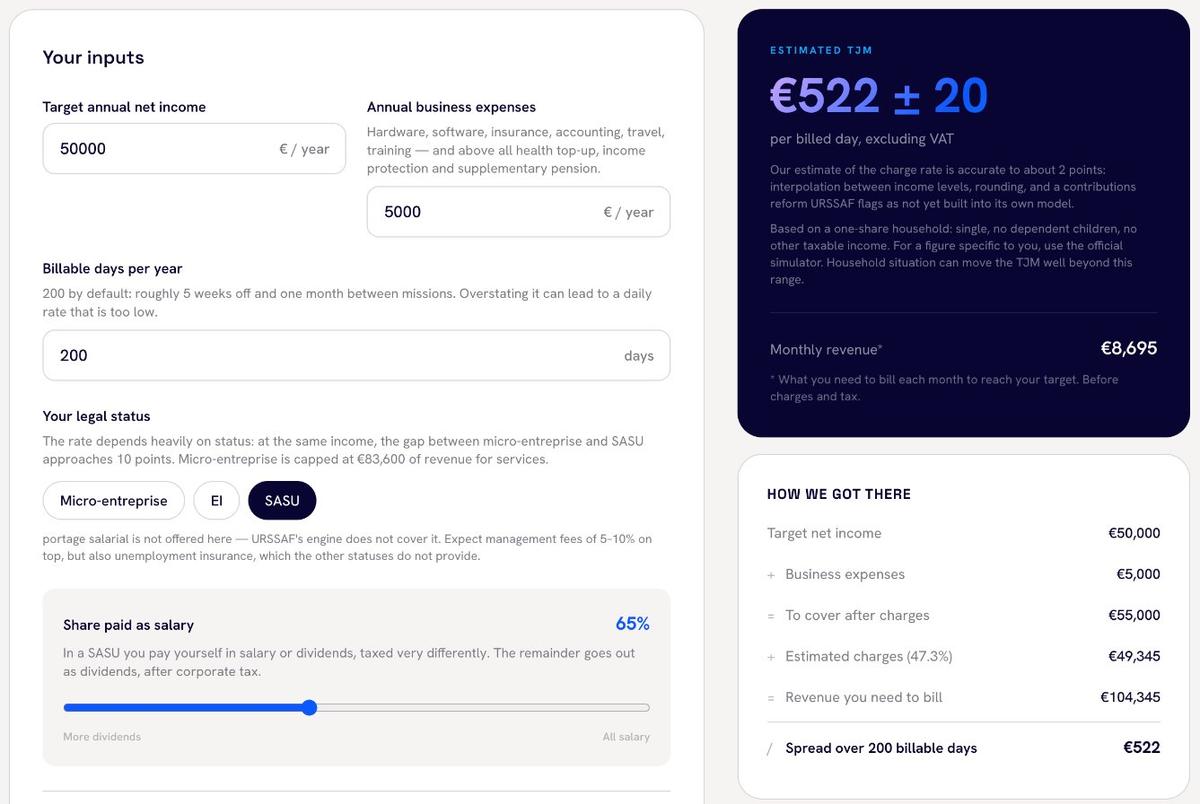
The floor is the number you don't go under. Your rate sits above it, depending on what your experience and the mission are worth.
How do you defend your rate without negotiating against yourself?
Give the number, give the reason once, then stop talking.
The usual mistake isn't the number. It's what comes after it: the nervous justification, the "but it's flexible", the discount offered before anyone asked. Every sentence after the number sounds like an invitation to lower it.
A few phrasings you can reuse:
- "My rate is [your rate] a day. It reflects [X] years on missions like this one in [sector]." Then wait.
- If the client says it's above budget: "What budget did you have in mind? Let's see which scope fits it." You adjust the work, not the price.
- If they ask for a discount on a long mission: "For a three-month commitment, I can offer [one specific, limited concession]." A trade, not a reduction.
When your price says the same thing as the rest of your profile, it stops being the topic and the conversation moves to the work.
That is also why how you work matters as much as what you charge. A client who can see how someone works no longer has to guess from the price. If you are weighing missions right now, here is how to tell whether one fits the way you work. And when your rate is set, Migbirds can show you missions that match how you work.

Robertino Calcaterra
Growth & Marketing at Migbirds